
A great relay takeoff can shave real time off your split, but a takeoff that’s even a hair too early can get your entire team disqualified. That tension is what makes relay exchanges one of the hardest skills in swimming to master — you’re trying to leave the block at the exact instant your teammate’s hand hits the wall, not a beat before.
This guide breaks down how relay exchange rules actually work, the arm-swing mechanics that get you off the block fast, and the practice routine that turns good timing into a reflex instead of a guess.
Quick Answer
To nail a relay exchange, start your arm swing as your incoming teammate takes their final stroke, time your feet leaving the block so they lift the instant (not before) the incoming swimmer’s hand touches the wall, and stay low through the swing so your momentum carries forward into the water rather than up into the air. Getting this right takes repeated practice with real teammates at race pace — it’s a timing skill, not a one-time technique fix.
How the Relay Exchange Rule Actually Works
In competitive swimming, the outgoing swimmer’s feet must stay in contact with the starting block until the incoming swimmer physically touches the wall (or touchpad). If the outgoing swimmer’s feet leave the block before that touch happens, it’s an early takeoff — and it results in disqualification for the whole relay team, regardless of how the race finishes.
At meets with electronic timing, a takeoff pad built into the starting block is linked to the touchpad in the water. The system measures the gap between when the incoming swimmer’s hand hits the touchpad and when the outgoing swimmer’s feet leave the block, and that printout is used to confirm legal or illegal exchanges. At meets without that equipment, human relay takeoff judges are stationed at each end of the pool specifically to watch for early takeoffs, often using a ‘toes to touch’ technique — watching the feet leave the block first, then immediately checking whether the touch has already happened, so borderline calls get the benefit of the doubt.
The practical upshot: there’s no such thing as a takeoff that’s ‘a little early but still fine.’ Your margin for error is essentially zero, which is exactly why timing technique matters so much more in relays than in an individual start.
The Timing Technique: Arm Swing, Stance, and Cues
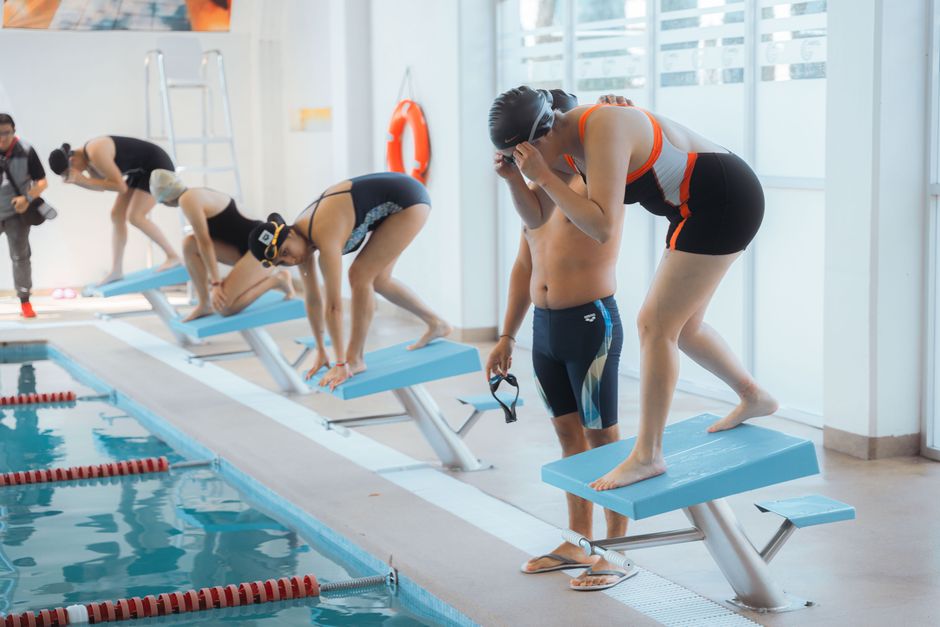
Most swimmers use an arm-swing start for relay exchanges. The idea is to build momentum with your arms and a forward step so you can explode off the block the instant your teammate touches, rather than starting from a static crouch like an individual race start. Some swimmers swing their arms in a full circle; others just swing back to front from waist height into a streamline. The exact path matters less than the result — a fast, purposeful motion that flows straight into a tight streamline entry.
The key skill isn’t the arm swing itself, it’s syncing that swing to your incoming teammate’s final stroke. Watch their approach to the wall in the last few meters and pick a consistent visual cue — the moment their head drops for the final stroke, or the moment their hand starts its final reach — and start your arm swing on that cue every single time. Consistency in when you start the swing is what lets you consistently finish it at the right instant.
Stay low as you swing and step. A common error is standing up out of the crouch too early, which sends your body’s momentum upward instead of forward and actually slows your entry. Keep your hips loaded and drive forward, not up, so the swing converts directly into distance off the block.
As a rule of thumb for judging risk: leaving late costs you a fraction of a second of split time. Leaving early costs your team the entire race. When you’re unsure whether you have the timing dialed in, err toward late until you’ve built confidence with reps.

How to Practice Relay Exchanges
Exchange timing is a rhythm skill, so it has to be practiced against real swimmers, not a stopwatch alone. Rotate through teammates of different speeds and different strokes during practice — someone finishing a fast freestyle leg approaches the wall very differently than someone finishing a breaststroke leg, and your cue timing needs to adapt to both.
Put a coach or teammate on the wall specifically to watch both the touch and the takeoff together, since it’s very hard for the swimmer on the block to self-judge whether they went early. Video review from behind the block, in line with the touchpad, is one of the most reliable ways to confirm exactly how close (or how risky) your timing actually was.
Build relay exchanges into a regular short block of practice — even just a few minutes at the end of a session, a couple of times a week — rather than only working on them right before a meet. Early reps should focus purely on getting the rhythm and repetition right; don’t worry about shaving hundredths until the basic timing feels automatic.
Tips / Common Mistakes
Hesitating is the most common flaw — a tentative, delayed arm swing kills the momentum you’re trying to build, so commit fully to the motion once you start it. Standing up too soon during the swing is the second most common issue, since it sends energy upward instead of forward into the water.
Don’t fixate on your teammate’s hand alone — watch their whole approach (head position, stroke rhythm, last kick) so you have multiple cues confirming the same timing, which makes you less likely to jump on a false read. And don’t chase perfect timing before you’ve built the raw mechanics: get the arm swing and streamline entry clean first, then layer in the precise timing against a real incoming swimmer.
Finally, treat every practice exchange like it counts. Sloppy, casual reps in practice tend to show up as sloppy timing under meet pressure, when the stakes for going early are highest.
Explore more: More swimming training and technique guides.
Relay exchange timing FAQs
What happens if a swimmer leaves the block before the touch in a relay?
It’s an early takeoff, which results in an automatic disqualification for the entire relay team, even if the team otherwise finishes the race legally.
Is it better to leave a little late or risk leaving early?
Leave a little late. A late takeoff only costs your team a small amount of split time, while an early takeoff disqualifies the whole relay regardless of the final result.
How do officials know if a relay takeoff was early?
At meets with electronic timing, a takeoff pad on the block is compared electronically to the touchpad in the water to measure the exact gap between the touch and the takeoff. At meets without that equipment, dedicated relay takeoff judges watch each exchange, typically using a ‘feet leave the block, then check the touch’ method to make the call.
Level Up With SportsSteps
Track your athlete’s progress, connect with coaches and your team, and grow — get the SportsSteps app. Get the SportsSteps App.
Want training tips and sports news in your inbox? Subscribe to the free newsletter.
Photo by Sergio Benavides on Pexels.