
If your kick sets feel like a break from “real” swimming rather than a way to get faster, you’re not alone. Most swimmers grab a kickboard, kick a few laps at an easy pace, and move on without ever training the kick with the same intent they bring to their stroke work.
A kick set only pays off when it’s built with a purpose — endurance, power, or speed — and when what you practice on the board actually shows up in your stroke. Here’s how to put one together that does both.
Quick Answer
An effective kick set picks one goal (endurance, power, or speed), uses the right gear for that goal (board, fins, or neither), and finishes by transferring the kick rhythm directly into swimming — for example, alternating a kick length with a swim length at matching tempo.
Step 1: Pick a Goal and Match the Gear to It
Don’t just “kick for a while.” Decide what you’re training that day. For kicking endurance, use longer efforts — repeats of roughly 50 to 100 meters or a minute at a time, with short rest, done without fins to build real leg stamina. For leg strength and power, short, maximal bursts work better: 20 to 25-meter all-out efforts with fuller rest, trying to kick hard enough that your shoulders want to lift out of the water.
Fins change the workout, not just the speed. Long-blade fins add resistance and force a bigger range of motion, which is great for building strength but will slow your stroke rate down. Short-blade fins let you move faster and groove a quicker kick tempo closer to race speed, while still giving a propulsion boost that helps overworked shoulders recover between harder swim sets.
If you’re specifically trying to improve your underwater dolphin kick off walls and starts, fins are useful early in a set to increase the propulsive surface of your feet and overload the motion — then take them off later in the same set so you feel the unassisted kick at a similar effort level.
Train smarter with a free AI coach. Create a free account →
Step 2: Structure the Set With Real Intervals
Vague kicking doesn’t build anything. Give every repeat a distance, a target effort, and a rest interval, just like you would for a swim set. A simple endurance builder is five rounds of one minute of continuous kicking, holding a steady hard effort, with 20 to 30 seconds rest between rounds. A simple power builder is ten rounds of 20-second maximum-effort kicks with roughly a minute of rest, so you’re recovering fully enough to go hard each time.
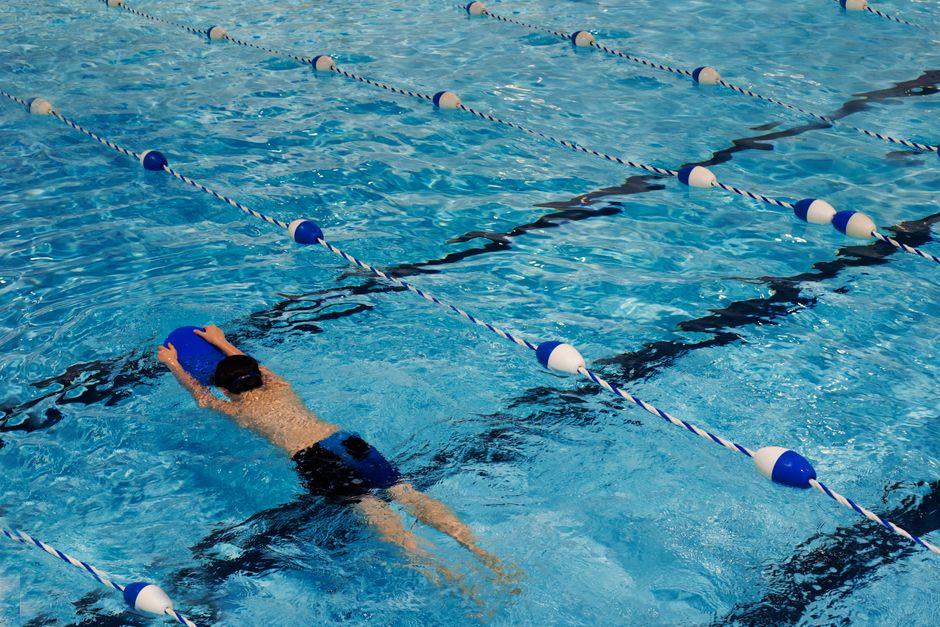
Watch your body position, not just your gear. Kicking with your head up on a board for long stretches tends to let your hips and legs sink, since lifting the head and chest tilts the rest of the body down — the opposite of the flat, horizontal line you want in your stroke. Mixing in kicking on your back, on your side, or in a streamline off the wall keeps your head in a more neutral position and trains your legs to hold the hips up the way they have to during actual swimming.
Build toward a kick-to-swim set rather than ending on kicking alone. A common approach: kick 100 meters, immediately swim 100 meters at the same tempo, then repeat for several rounds. The goal each round is to notice your fastest, strongest kicking and consciously carry that same leg speed into the swim — that transfer is what actually changes your stroke.
Tips and Common Mistakes
Biggest mistake: treating kick sets as recovery. If every kick repeat is slow and relaxed, your legs never adapt and the set does nothing for your swimming — save true recovery kicking for active rest between hard swim reps, not for a dedicated kick set.
Second mistake: kicking head-up on a board for every repeat. Holding your head up lets your hips drop and can train a lopsided kick that does most of its work on the downbeat instead of up and down. Mix in board-free kicking — on your back, on your side, or in a streamline — so your body learns to kick while staying level.
Third mistake: using fins every time. Fins mask a weak kick by doing some of the work for you. Alternate fin and no-fin repeats within training blocks so you’re building genuine leg strength, not just fin-assisted speed.
Finally, always connect the kick back to your stroke before the set ends. A hard kick set that never gets paired with swimming at matching tempo is a good leg workout, but it won’t necessarily make you faster in the water.
Explore more: more swimming training guides.
Kick set training FAQs
How often should I do kick sets?
Most swimmers get solid benefit from kick-focused work two to three times a week, either as a dedicated short set within a regular practice or as part of a warm-up or cool-down.
Should I use a kickboard or no board at all?
Both have a place. A board is fine for building raw leg endurance and power, but also kick without one — on your back or in a streamline position — so your hips don’t drop the way they tend to when your head stays lifted on a board.
Do fins help or hurt kick training?
Both, depending on how you use them. Fins build leg strength and let you recover shoulders during hard sets, but relying on them constantly can mask a weak kick, so mix in fin-free repeats.
What’s a simple kick set a beginner can try?
Try 5 rounds of 1 minute of continuous kicking at a strong, steady effort with 20-30 seconds rest between rounds, then finish with a few lengths of easy swimming focusing on keeping that same leg rhythm.
Level Up With SportsSteps
Train smarter with a free AI coach
Log workouts, follow a training plan, and see your progress over time — for athletes at every level.
Create a free accountFor families, athletes, coaches & clubs
Want training tips and sports news in your inbox? Subscribe to the free newsletter.
Photo by Leonardo Borneva on Unsplash.