
If you’ve ever watched a coached swim practice, you’ve probably heard someone shout ‘breathe to both sides!’ — and if you’ve ever tried it mid-set, you know how disorienting that can feel. Bilateral breathing (the practice of alternating which side you breathe on during freestyle) is one of those skills that feels counterintuitive at first but pays off enormously over time.
Whether you’re a recreational lap swimmer, a triathlete, or an open water enthusiast, learning to breathe on both sides will improve your stroke balance, reduce your injury risk, and give you options when conditions get tough. This guide covers what bilateral breathing actually is, why coaches push it so hard, and exactly how to build it into your training without losing your mind.
Quick Answer
Bilateral breathing means breathing on both sides during freestyle swimming, typically by inhaling every three strokes so you alternate left and right. It promotes a balanced, symmetrical stroke and is especially useful in open water — but it takes deliberate practice and shouldn’t be attempted for the first time during a race or a hard training set.
Why Bilateral Breathing Matters
The most compelling reason to breathe bilaterally is stroke symmetry. When you always breathe to the same side, your body naturally rotates more on that side and less on the other. Over weeks and months this creates muscular imbalances — one shoulder does more of the pulling, one hip drives less rotation — and those imbalances quietly drag your times down and raise your injury risk.
Breathing bilaterally forces you to practice proper body rotation on both sides, which strengthens both sides of your core and back equally. Many swimmers discover that once they develop a truly even stroke, their ‘good’ breathing side actually gets better too, because they start to understand what clean rotation actually feels like.
In open water and triathlon, the tactical case is even stronger. You might need to sight a buoy to your left, check where a competitor is on your right, or avoid breathing into a wave coming from one direction. If you only ever breathe to one side, you’re operating with a blind spot. Developing bilateral breathing in the pool means you have genuine choices when it counts.
How to Practice: A Step-by-Step Approach
Start during warm-up, not during hard sets. This is the single most important rule. When you’re tired or racing, you’ll automatically revert to your comfortable side — that’s not the time to wire in a new pattern. Reserve bilateral practice for easy, low-pressure laps where you can actually focus on technique.
Use gear to make the learning curve gentler. Fins or a pull buoy reduce the physical demand enough that you can concentrate on your breathing mechanics without gasping. Once the pattern starts to feel natural with a pull buoy, gradually remove the crutch.
Nail your underwater exhale first. A huge reason bilateral breathing feels suffocating is that swimmers hold their breath underwater and then try to both exhale and inhale in the fraction of a second their mouth clears the surface. Practice exhaling steadily through your nose or mouth while your face is submerged — by the time you rotate to breathe, your lungs should be nearly empty and ready for a quick, full inhale.
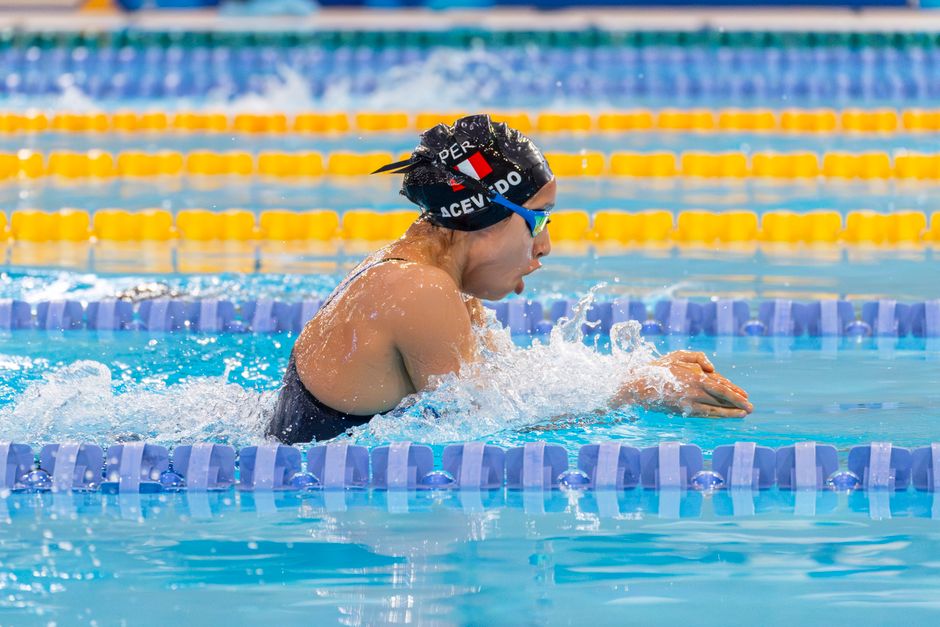
Focus on rotation, not head lifting. When you breathe, your head should rotate with your body — one goggle stays submerged, the other rises just above the surface. You breathe into the small pocket of air created by your forward motion (‘the bow wave’). If you lift your head upward rather than rotating sideways, your hips sink and you’ll feel like you’re fighting the water. Turn, don’t crane.
Useful breathing patterns to try: Every three strokes (the classic bilateral pattern — one breath left, three strokes, one breath right) is the most common starting point. If three strokes leaves you breathless, try a 3-2-3-2 pattern, where you take two breaths on one side before switching, or try breathing to your weaker side on alternate lengths rather than every single breath. Any pattern that includes both sides counts as progress.
Helpful drills: Side kick drills build the rotation awareness you need. Swim one full length breathing only to your weaker side, then one length to your stronger side, and compare how they feel. As the gap narrows, mix bilateral breathing into your main sets — starting with just one or two lengths per session and building over weeks.
Tips and Common Mistakes to Avoid
Don’t try it during a race or a tough interval set. You’ll revert to your dominant side anyway, and you might reinforce the idea that bilateral breathing ‘doesn’t work.’ Keep hard efforts for your practiced pattern and use easy swimming for skill development.
Don’t expect it to click immediately. Switching sides can temporarily make your stroke feel completely foreign — your timing feels off, you might swallow water, and it may seem hopeless. This is normal. The awkwardness fades with consistent repetition, typically over several weeks of regular practice.
Don’t skip the weaker side just because it’s uncomfortable. That discomfort is the signal that the imbalance is real. Leaning into it (gently, consistently) is exactly how you fix it.
If you have a shoulder injury or structural issue that makes one side painful, talk to a coach or physio before forcing bilateral breathing. For some swimmers, modifying the pattern or focusing on mechanics first is the right call — the goal is a balanced, healthy stroke, and there’s more than one way to get there.
Video yourself from above and from the front to compare both sides. Seeing the asymmetry in your stroke is often the most motivating thing you can do — and seeing it even out over time is genuinely satisfying.
Explore more: More swimming tips and guides.
Bilateral Breathing in Swimming FAQs
Do I need to breathe every 3 strokes to breathe bilaterally?
No. Breathing every three strokes is the most common bilateral pattern, but any pattern that includes both sides qualifies. Options like every five strokes, alternating sides by length, or a 3-2-3-2 pattern all develop bilateral breathing — choose what lets you maintain good technique without feeling desperate for air.
Will bilateral breathing slow me down?
In the short term, it may feel slower because you’re disrupting your established rhythm. Over time, most swimmers find that the improved stroke balance and symmetry make them more efficient overall. For competitive sprints, many swimmers revert to their dominant side — bilateral breathing is primarily a training tool that builds a better stroke.
How long does it take to get comfortable breathing to both sides?
It varies widely. With consistent practice a few times per week — especially during warm-ups and drills — many swimmers begin to feel noticeably more comfortable within four to six weeks. Full comfort where both sides feel equally natural can take several months of patient, regular practice.
Level Up With SportsSteps
Track your athlete’s progress, connect with coaches and your team, and grow — get the SportsSteps app. Get the SportsSteps App.
Photo by Gentrit Sylejmani on Unsplash.