
Volleyball serving drills for young players turn the most pressure-packed moment in the sport — standing alone behind the line — into a confident, repeatable skill. Serving is the only play in volleyball where the player controls everything: the toss, the contact, the placement. That makes it the highest-leverage skill a young player can develop. The drills below progress from underhand basics to topspin float serves and target hitting, and they work for ages 8-14 across rec, club, and middle school programs.
Volleyball Serving Drills for Young Players: Underhand Serve Mastery First
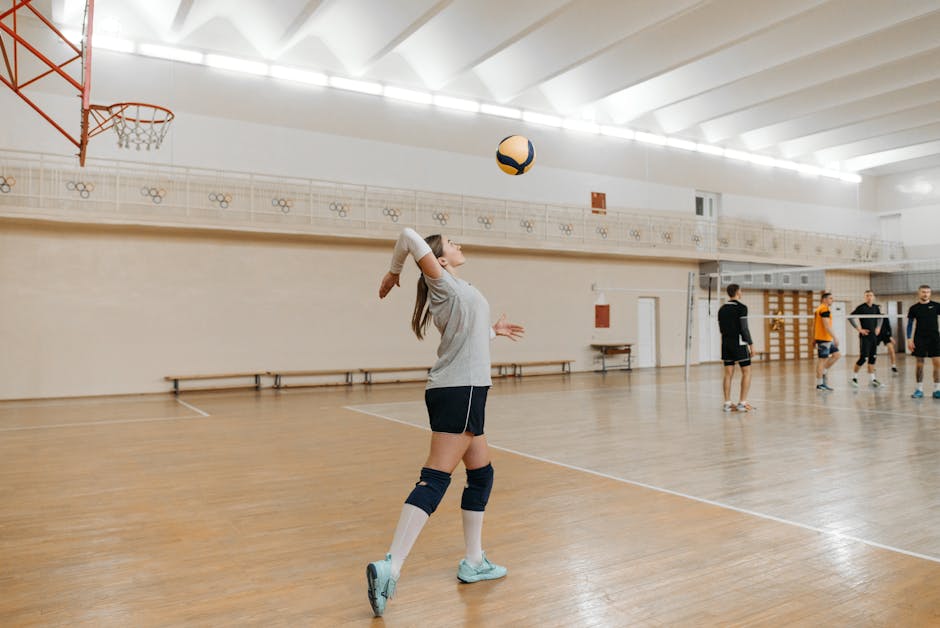
Every young player should master the underhand serve before touching an overhand. The underhand teaches arm-swing mechanics, contact point, and weight transfer in a low-pressure way. Stand with the non-dominant foot forward, hold the ball in the non-dominant hand at waist height, and swing the dominant arm through the ball with a firm, flat fist.
The most common mistake: tossing the ball before the serve. Don’t. The ball stays in the holding hand until the moment of contact. According to USA Volleyball, beginners who learn proper underhand mechanics first transition to overhand serves much faster than those who skip ahead.
Drill it: 20 underhand serves to a partner across a low net. Focus on consistent contact in the same spot every time. Then add a target — a hula hoop on the floor — and see how many of 20 serves land in the hoop.
Volleyball Serving Drills for Young Players: Toss Consistency for the Overhand Serve
The toss is the entire overhand serve. A bad toss makes a good swing impossible. Have players practice tosses with no swing at all — just toss the ball 1-2 feet above their hitting hand and let it drop to the floor in front of their hitting shoulder. If the ball lands on the same spot 10 times in a row, the toss is consistent enough to add a swing.
For the overhand serve, the toss should be in front of the body and slightly above the hitting shoulder. The player’s hitting arm draws back like an archer and swings through the ball with a firm, open hand. Contact happens at the highest point of the toss.
Drill it: 20 toss-only reps, then 20 toss-and-swing reps focusing on contact point. For more on building general athletic foundations, see our warm-up routines for youth sports practice.
Volleyball Serving Drills for Young Players: Target Serving for Game Realism
Once the basic mechanics are solid, add targets. Place cones, towels, or hula hoops in the corners of the opposite court. Have players serve 10 balls at each target and track makes. Most young players can hit 4-6 of 10 with practice.
Target serving is where servers become weapons. Coaches at higher levels score serves on a 0-3 scale: 0 for a missed serve, 1 for an in-bounds serve, 2 for a serve that forces a poor pass, and 3 for an ace. Track this scoring at practice and watch competition drive improvement.
The CDC’s youth activity guidelines support skill-based practice as one of the most engaging ways to keep kids physically active and motivated.
Volleyball Serving Drills for Young Players: Pressure Serving Drills
Real games create pressure that practice rarely matches. Build it into your serving drills. Try “serve to win” — the team that gets 5 serves in first wins; missed serves erase points. This adds consequence to every rep and trains young players to focus when it matters.
Another classic: “must-make” serving. Each player must make 3 serves in a row before they can leave practice. Start with 3, build to 5, then 7. The mental discipline of stringing makes together transfers directly to game pressure.
For team-level work, simulate end-of-set pressure: the team serving needs an ace to win the game. Run this 10 times per practice and watch confidence build.
Building a Daily Serving Routine
Young players who improve the fastest serve every day at home — not just at practice. A backyard, garage, or driveway with a wall works fine. A simple routine: 30 underhand serves, 30 overhand serves, and 20 target serves. That’s 80 reps in about 15 minutes.
Pair this with our advice on building confidence in young athletes and you’ll see kids walk to the service line without that knot in their stomach. Consistency is built rep by rep, not magic.
The best part: serving improvement shows up immediately in games. A player who makes 8 of 10 serves instead of 4 of 10 transforms their team’s chances of winning every match.
Frequently Asked Questions
At what age can kids start serving in volleyball?
Most kids can begin underhand serving around age 8. Overhand serving usually starts around age 10-11 when they have the strength.
Should beginners learn underhand or overhand serving first?
Always start with underhand. It builds the mechanics and confidence needed for a successful transition to overhand.
How many serves should a young player practice each day?
Aim for 50-100 serves daily across multiple short sessions. Frequency builds muscle memory faster than long sessions.
Why does my child miss so many serves into the net?
Usually a low toss or a downward arm swing. Have them toss higher and finish the swing toward the target.
When should young players start adding spin to their serves?
Master a flat, consistent serve first. Topspin and float serves typically come around age 12-13 with proper coaching.
Build the complete skill set with our youth volleyball skills training guide.