
If you’ve looked at swim data from a pool clock, a coach’s clipboard, or a smartwatch, you’ve probably seen two numbers that sound similar but measure completely different things: stroke rate and stroke count. Mixing them up makes it hard to know whether you’re actually improving.
This guide breaks down what each metric tells you, how they relate to your swimming speed, and how to use both together to build a more efficient stroke instead of just swimming harder.

Quick Answer
Stroke rate (also called tempo) is how many strokes you take per minute — a measure of turnover speed. Stroke count is how many strokes you take to complete one length of the pool — a measure of distance covered per stroke. Speed comes from combining the two: swim speed is essentially stroke rate multiplied by stroke length (the distance each stroke moves you), so a faster stroke rate only helps if it doesn’t shrink your stroke length too much.
What Each Metric Actually Measures
Stroke rate is a tempo number, usually expressed as strokes per minute (SPM) or the time between strokes in seconds. Coaches time it by counting strokes over a set period, or swimmers use a waterproof metronome clipped to goggles or tucked under a cap that beeps at a chosen interval, cueing one stroke per beep. A higher stroke rate means your arms are cycling faster, independent of how far each stroke actually moves you through the water.
Stroke count is simply the number of strokes it takes to swim one length of the pool, counted from the first hand entry after the wall to the hand entry that touches the far wall. From stroke count you can calculate distance per stroke (DPS): pool length divided by stroke count. A 25-yard length covered in 14 strokes means roughly 1.8 yards per stroke — a rough proxy for how much ‘glide’ or propulsion you’re generating per arm cycle.
The two numbers pull against each other. Speed up your stroke rate without changing anything else and your stroke count for the same speed will usually creep up too, because faster turnover often means slightly shorter, choppier strokes. Slow your rate down and focus on reaching further per stroke, and your stroke count typically drops — but so might your speed, if you’re gliding too long between strokes.
Using Both Metrics Together
Neither metric is ‘better’ in isolation — the point is to find the combination that produces the most speed for the least wasted effort. A useful way to think about it: swim speed equals stroke rate times stroke length (distance per stroke). You can hit the same speed with a slow, long stroke or a fast, shorter one, but one of those is usually more sustainable for a given swimmer and a given race distance.
In practice, most swimmers benefit from first building a long, efficient stroke (low stroke count, high DPS) in easy aerobic swimming, then gradually raising stroke rate while trying to hold onto as much of that stroke length as possible — rather than letting rate increases turn into short, frantic strokes. A tempo trainer or metronome app is the standard tool for this: set a target beep interval, hold it for a set of repeats, then nudge the tempo slightly faster every few weeks while checking that your stroke count per length doesn’t balloon.
A combined metric some swimmers track is SWOLF (swim golf): add your time in seconds for a length to your stroke count for that length. A lower SWOLF generally reflects better overall efficiency, since you can lower it either by swimming faster or by taking fewer strokes — but it should always be read alongside pace, since a swimmer can lower SWOLF just by slowing down and gliding more, which isn’t actually useful in a race.
Tips / Common Mistakes
Don’t chase a low stroke count for its own sake. Gliding to minimize strokes per length often means dead spots where you’re decelerating between strokes — great for a drill, bad for race pace. The goal is distance per stroke at race speed, not at a crawl.
Don’t raise stroke rate by rushing the front of the stroke. A common mistake is yanking the hand through the catch faster, which shortens the stroke and burns more energy for the same or less speed. Increase rate by shortening the recovery (the part of the stroke above or beside the water) rather than rushing the pull.
Track stroke count per length against your pace, not against another swimmer. Taller swimmers and swimmers with longer wingspans will naturally take fewer strokes per length; stroke count is only meaningful compared to your own past numbers at a matched speed.
Re-test periodically rather than once. Stroke rate and count both drift with fatigue, so compare numbers from similar points in a workout (e.g., first rep of a set vs. first rep of a set) instead of comparing a fresh rep to an exhausted one.
Explore more: more swimming technique and training guides.
Stroke rate vs stroke count FAQs
Is a lower stroke count always better?
Not necessarily. A lower stroke count means more distance per stroke, which is usually a sign of efficiency, but only if your pace stays the same or improves. Taking fewer strokes by gliding and slowing down isn’t actually more efficient for racing.
What’s a good stroke rate for freestyle?
It varies widely by stroke, distance, and swimmer, which is why coaches set individual targets rather than a single universal number. Distance freestylers typically hold a slower, longer stroke than sprinters, who turn their arms over much faster.
How do I measure my stroke count in a pool?
Count your hand entries from your first stroke after pushing off the wall to the hand that touches the far wall, for one length. Doing this consistently at the same pace over several lengths gives you a reliable baseline to track changes against.
What tool do swimmers use to train stroke rate?
A waterproof tempo trainer or metronome, worn under a cap or clipped to goggles, beeps at a set interval so the swimmer takes one stroke per beep. Swimmers use it to hold a steady turnover and gradually adjust that turnover over time.
Level Up With SportsSteps
Track your athlete’s progress, connect with coaches and your team, and grow — get the SportsSteps app. Get the SportsSteps App.
Want training tips and sports news in your inbox? Subscribe to the free newsletter.
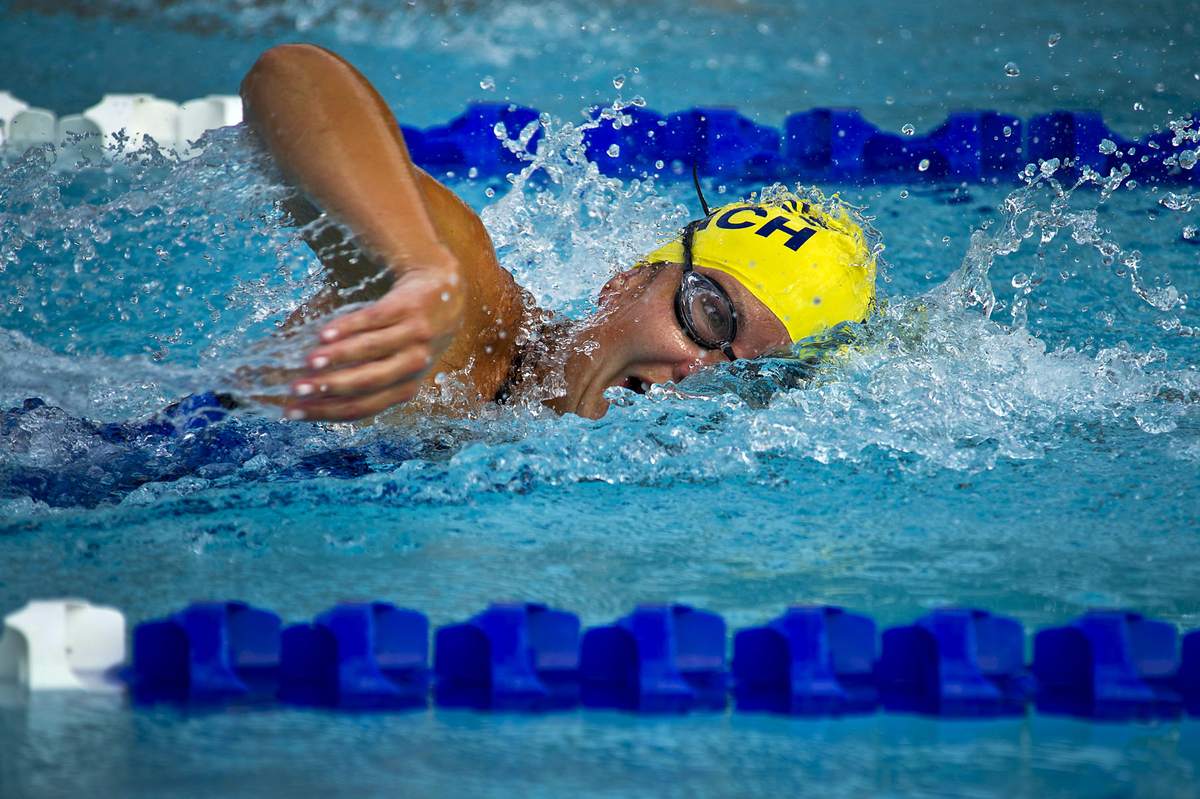
Photo: Staff Sgt. Mike Meares / Public domain, via Wikimedia Commons.