
Walk into almost any swim practice and you’ll see it: a giant clock on the wall or deck with no hour hand, just a sweeping second hand and a bunch of numbers that don’t mean what a normal clock’s numbers mean. That’s a pace clock, and it’s how coaches control rest, timing, and spacing between swimmers without ever blowing a whistle.
If you’re new to structured swim workouts, the pace clock can feel like its own language — “go on the top,” “leave on the bottom,” “you’re on a 1:40.” This guide breaks down exactly what those phrases mean and how to use the clock with confidence in your very next practice.

Quick Answer
A pace clock is a large, second-only clock used to time swims and rest intervals. Read it by watching where the sweeping hand points: the 60 at the top of the dial is called “the top,” and the 30 at the bottom is “the bottom.” Swimmers push off the wall at a number the coach assigns, then use the clock again to see how long their next swim and rest take.
What’s Actually on the Clock Face
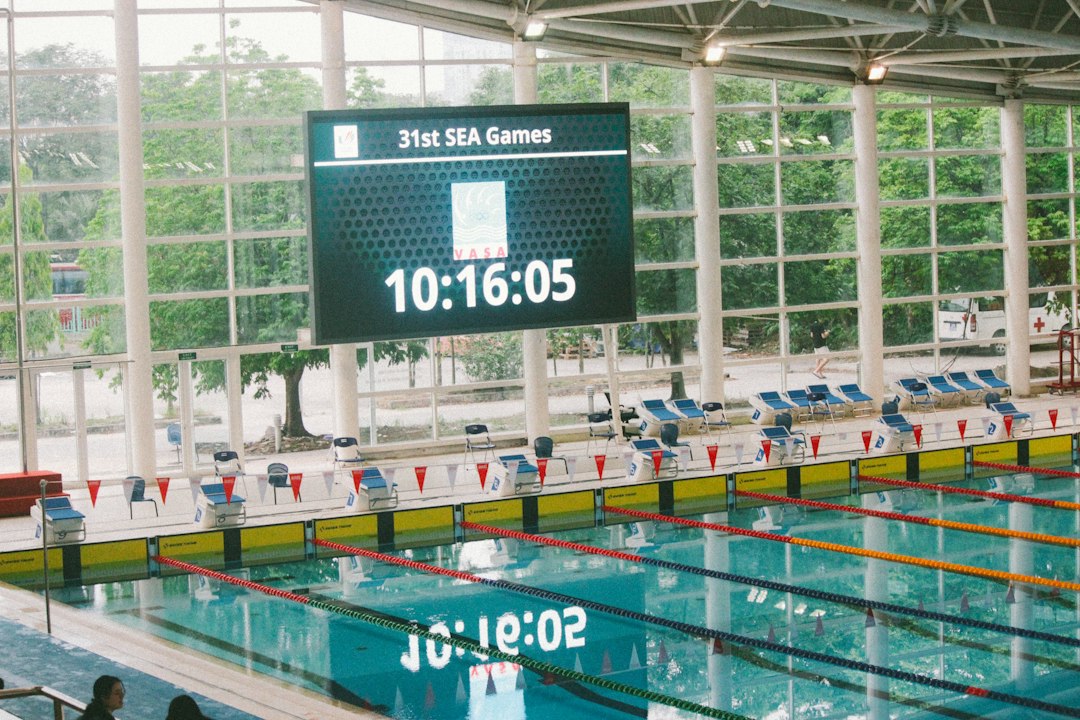
Unlike a wall clock at home, a pace clock has no hours and usually no separate minute hand. Instead, the dial is marked 0 through 60 in 5-second increments, and a single sweeping hand makes one full loop every 60 seconds. Many pace clocks use a two-tone hand — half black, half red — so coaches and swimmers on the far side of the pool can easily tell where it’s pointing even from a distance. Some newer pool decks use digital pace clocks that display the running time as numbers instead of a sweeping hand, but they work the same way underneath: they’re just stopwatches that never stop.
Because there’s no “12” on a pace clock, swimmers borrow clock-face language instead. The 60 at the top of the dial is called “the top,” and the 30 at the bottom is “the bottom.” A coach saying “we’ll start on the top” simply means: wait until the hand reaches 60, then push off.
Using the Clock for Sets and Send-Offs
In practice, the pace clock does two jobs: it tells you when to leave the wall (your send-off) and it tells you how much rest you get before the next repeat. A typical set might be written as “8 x 100 on 1:40,” which means you swim 100 yards or meters, and exactly 1 minute 40 seconds after you left the wall, you leave again for the next 100 — whether you finished early or not. If you swim the 100 in 1:25, you get 15 seconds of rest; swim it in 1:35, you only get 5 seconds.
When multiple swimmers share a lane, they don’t all leave at once. Instead, each swimmer leaves a set number of seconds after the one in front of them — commonly 5 or 10 seconds apart — so there’s no pileup at the wall. If the lane leader starts on the top (60), the second swimmer might leave on the 5, the third on the 10, and so on.
To time yourself, note where the hand is when you push off, then watch where it is when you finish. If you left on the 20 and the clock reads 55 when you touch the wall, your swim took 35 seconds. For swims longer than a minute, just keep count of how many times the hand passes the 60 as you swim.
Tips and Common Mistakes
The most common beginner mistake is panicking about the exact second and losing track of the set entirely. If you’re unsure, just follow the swimmer in front of you and leave a consistent gap behind them — you don’t need to read the clock perfectly to stay on pace with your lane.
Another frequent mix-up is confusing “on the top” with “on the bottom.” Top means 60 (or 0), bottom means 30 — they’re opposite sides of the same circle, so starting on the wrong one puts you exactly half the interval off from everyone else.
It also helps to glance at the clock before you push off, not after. Knowing your send-off number in advance means you’re not scrambling to calculate anything mid-swim — you already know what number you need to see when you finish to know your time.
Finally, don’t ignore the rest portion of an interval set. The clock is there as much for recovery pacing as for speed; leaving early to “beat the clock” defeats the purpose of a controlled interval and can throw off your pacing for the rest of the set.
Explore more: more swim training tips.
Pace clock FAQs
What does “on the top” mean on a pace clock?
It means you start your swim when the clock’s sweeping hand reaches the 60 at the top of the dial, similar to how “12” works on a normal clock.
Why doesn’t a pace clock have an hour hand?
Pace clocks are built purely for timing short, repeated efforts in practice, so they only need a 60-second sweep hand (and sometimes a slower minute hand) rather than a full 12-hour display.
How do I know how much rest I’m getting on an interval set?
Subtract your swim time from the total interval. For example, on a 1:40 interval, a 1:25 swim gives you 15 seconds of rest before the next repeat starts.
Do digital pace clocks work differently than analog ones?
No — digital pace clocks show the same running seconds as a number instead of a sweeping hand, but the concept of send-offs, tops, and bottoms works the same way.
Level Up With SportsSteps
Track your athlete’s progress, connect with coaches and your team, and grow — get the SportsSteps app. Get the SportsSteps App.
Want training tips and sports news in your inbox? Subscribe to the free newsletter.
Photo by Taiki Ishikawa on Unsplash.