
Most halftime talks fail for the same reason: the coach tries to say everything. Fifteen points, a tactical lecture, and a motivational close all crammed into the walk from the field to the locker room and back — and players remember almost none of it. The talks that actually change the second half aren’t longer or louder. They’re built on a repeatable structure that respects how much a stressed, tired brain can actually absorb in a few minutes.
This guide breaks down that structure: how to open, how many points to make, how to split time between emotion and tactics, and what to do differently depending on the age and level of your team. It’s built around what coaches who write about team talks consistently find works — not a highlight-reel speech, but a repeatable routine.

Quick Answer
A good halftime talk follows a simple shape: let players settle for the first 60-90 seconds (they can’t process anything yet), name what actually happened in the first half honestly, give no more than two or three team-level adjustments, assign each player one specific focus for the second half, and end on a short, direct close. Structure beats eloquence — the same shape delivered flatly every time outperforms a brilliant speech improvised under pressure.
The Halftime Talk, Step by Step
Give players a buffer first. In the first minute or two off the field, players are still physically winded and mentally replaying the half — they are not absorbing instruction yet. Use this window for water, quick physical treatment, and letting assistant coaches gather notes, not for talking at the team.
Name what actually happened before adjusting anything. Players tune out a coach who either sugarcoats a bad half or only vents frustration. Pointing out something real and specific — ‘we’re getting beat to the ball in midfield’ or ‘our spacing on offense collapsed in the second quarter’ — is what makes the adjustment that follows land.
Limit yourself to three team points, max. Coaches who write about this often call it the Rule of Three (or ‘Rule of Three Plus One’): pick the handful of things that matter most, say them plainly, and stop. A team can’t execute on a dozen corrections at once, and trying to deliver that many just guarantees none of them stick.
Give each player one individual focus. After the team-level points, a single, concrete instruction per player — one technical or positional thing to do differently — tends to move the needle more than another round of team-wide reminders, because it’s specific enough to actually act on.
Use small-group or position-unit time for the tactical detail. If your team breaks into units (offense/defense, forwards/backs, etc.), that’s where X’s and O’s belong — not in the full-team address. Keep the whole-team portion short and let unit conversations carry the detailed tactical adjustments.
Close with a short, forward-looking line. End on something players carry back onto the field — a single sentence, not a new topic. The close is about direction and belief, not a summary of everything you just said.
Balancing Emotion and Tactics
Coaches often assume halftime is purely tactical, but the emotional tone of the talk matters just as much as its content — players who feel believed in and reconnected to the game plan tend to respond better in the second half than players who only receive a list of corrections. The goal isn’t choosing between a ‘pep talk’ and a ‘tactics talk’; it’s sequencing both: reconnect emotionally first, then deliver the few adjustments that matter.
That said, directness tends to beat artificial positivity. Players generally respond better to a coach who names the real problem plainly than to one who papers over a bad half with generic encouragement. The skill is staying calm and matter-of-fact while being honest — not staying silent about what went wrong.
Adjust the mix by age and level. Younger or developmental teams typically need more encouragement and simpler, fewer tactical points, with more room for questions. Older, more experienced teams can handle more direct, detailed adjustments and less hand-holding — but the core structure (settle, name reality, limit the points, individual focus, short close) holds at every level.
Tips / Common Mistakes
Don’t talk during the first 60-90 seconds — it’s wasted breath while players are still catching their breath and resetting mentally. Use that window for water and for your own notes instead.
Don’t exceed three team-level points. If your list is longer, you haven’t prioritized yet — cut it down before you walk into the room, not during the talk.
Don’t let frustration run the room. Players read a coach’s composure as much as their words; losing control of your tone undercuts even a well-structured talk.
Don’t use the full-team address for detailed tactics. Save X’s and O’s for position or unit meetings where there’s time to actually explain and confirm understanding.
Don’t skip the individual focus step. Team-wide points are easy to tune out; a specific note aimed at one player is much harder to ignore.
Don’t improvise the structure every time. Using the same shape every halftime — even when the talk itself changes — makes it easier for players to know what to listen for and easier for you to stay disciplined under pressure.
Explore more: More coaching strategy guides.
Halftime talk structure FAQs
How long should a halftime talk be?
Keep the full-team address short — roughly 60 to 90 seconds of direct talking time after players have had a minute to settle. Save longer, more detailed conversation for position or unit breakouts, which can run a couple of minutes each.
How many points should a coach make at halftime?
No more than two or three team-level points, plus one individual focus per player. More than that, and players won’t retain or execute on any of them.
Should a halftime talk be positive or critical?
Both, in sequence. Name what actually happened honestly rather than only offering generic encouragement, then move into a small number of specific adjustments, and close on something forward-looking and positive.
Does the structure change for youth teams versus older athletes?
The core shape stays the same, but younger or less experienced teams generally need simpler points, more encouragement, and more room for questions, while older or more advanced teams can handle more direct, detailed tactical feedback.
Level Up With SportsSteps
Track your athlete’s progress, connect with coaches and your team, and grow — get the SportsSteps app. Get the SportsSteps App.
Want training tips and sports news in your inbox? Subscribe to the free newsletter.
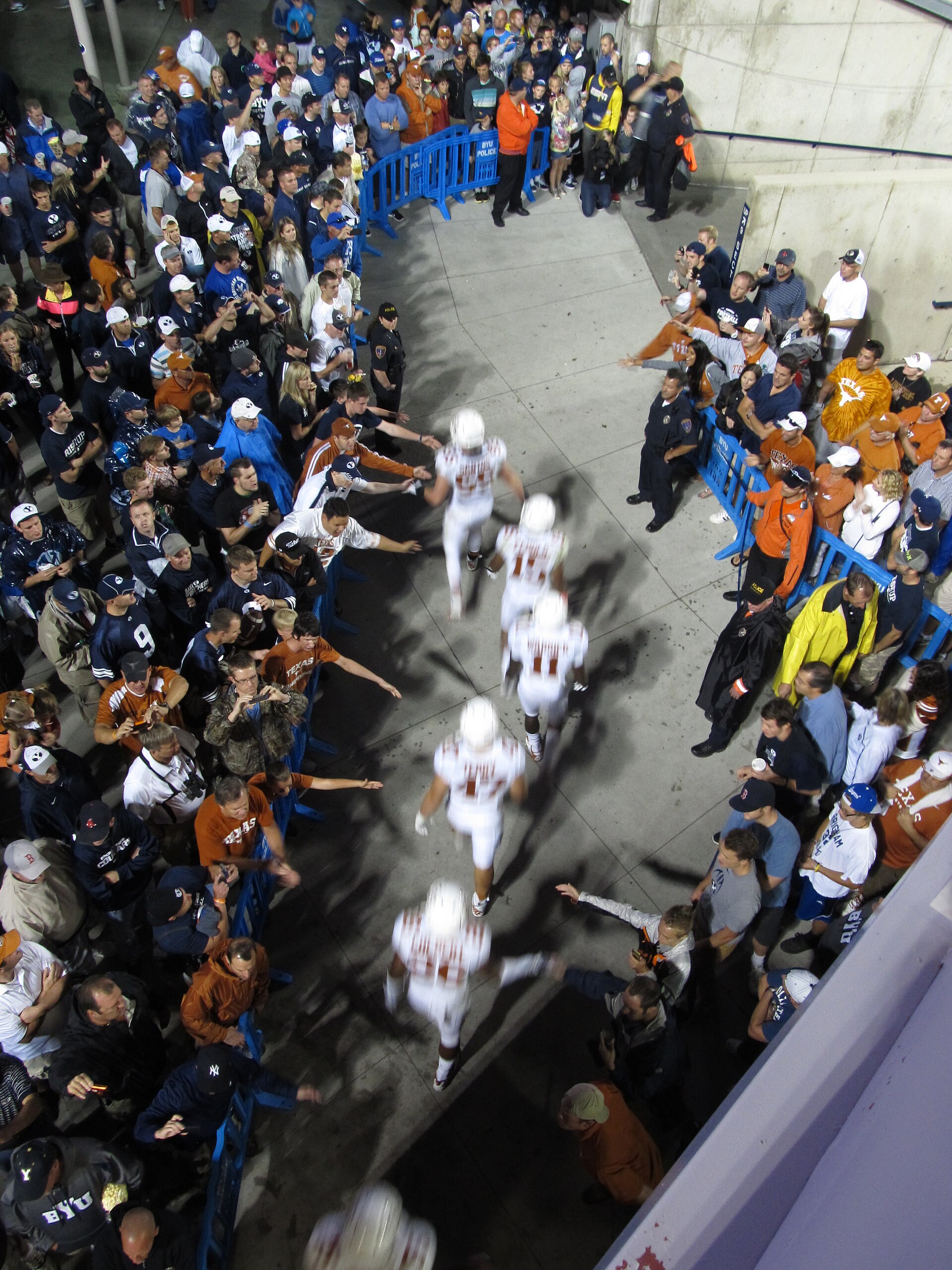
Photo: Ken Lund from Reno, Nevada, USA / CC BY-SA 2.0, via Wikimedia Commons.